Unlisted Companies in India: Top Companies, Examples, Shares, Benefits & Risks
 Jyoti Sirvastava
India's business landscape is much larger than the companies traded on the NSE and BSE. Many large and well-known businesses operate as unlisted companies, meaning their securities are not listed for regular trading on a recognised stock exchange.
Some unlisted businesses have grown to a very large scale before considering an IPO. The 2026 JM Financial-Hurun India Unlisted Gems report, for example, highlighted major businesses such as Reliance Retail, Flipkart, Malabar Gold & Diamonds, Tata Electronics and Tata Digital. The 100 companies covered in the report collectively generated about ₹8.9 lakh crore in revenue in 2025.
Unlisted companies are therefore an important part of India's corporate and investment ecosystem.
What Is an Unlisted Company?
An unlisted company is a company whose securities are not listed on a recognised stock exchange for regular public trading.
This means its shares are not traded on exchanges such as NSE or BSE in the same way as shares of listed companies.
An unlisted company can be:
- A private company
- An unlisted public company
- A subsidiary of a larger business group
- A government-owned enterprise that has not been listed
- A large startup preparing for a future IPO
- A family-owned or closely held business
Therefore, unlisted does not always mean private.
Listed vs Unlisted Company
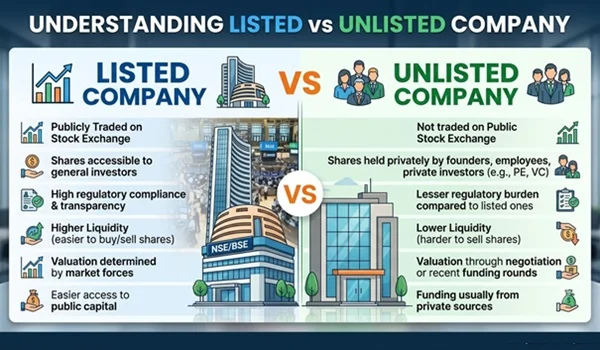
| Feature | Listed Company | Unlisted Company |
| Stock exchange listing | Yes | No |
| Shares traded on NSE/BSE | Generally yes | No regular exchange trading |
| Public market price | Available through market trading | Usually not continuously available |
| Liquidity | Generally higher | Generally lower |
| Public disclosures | Extensive | Depends on company and applicable law |
| IPO required for listing | Usually applicable for an IPO route | Not yet listed |
| Share transfer | Easier through market infrastructure | Usually subject to private transfer procedures |
An unlisted company may later become listed through an IPO or another permitted listing route.
Top Unlisted Companies in India
There is no single official ranking that includes every unlisted company in India. However, several large businesses are widely recognised as major players in the unlisted market.
The following companies appeared among the highest-revenue unlisted businesses in the 2026 JM Financial-Hurun India Unlisted Gems ranking:
| Company | Major Sector | 2025 Revenue* |
| Reliance Retail | Retail | ₹2,71,227 crore |
| Flipkart | E-commerce/Retail | ₹83,105 crore |
| Malabar Gold & Diamonds | Jewellery | ₹66,872 crore |
| Tata Electronics | Electronics/Semiconductors | ₹66,601 crore |
| Tata Digital | Digital/Retail | ₹32,188 crore |
| Adani Properties | Real Estate | ₹22,726 crore |
| OfBusiness | B2B/Financial Services | ₹22,499 crore |
| Tata Passenger Electric Mobility | Automobiles/EV | ₹15,247 crore |
| SBI General Insurance | Insurance | ₹14,140 crore |
| Haldiram Snacks Food | FMCG/Food | ₹14,000 crore** |
*Figures are based on the 2026 JM Financial-Hurun Unlisted Gems reporting.
**Haldiram figure is based on the filing period cited by the source.
Other well-known unlisted businesses in India include NSE, Serum Institute of India, Zerodha, Zoho, Razorpay, Parle Products and other large private or closely held businesses. Their ownership structures and valuations can change over time, so they should not automatically be treated as potential IPO candidates.
- Reliance Retail
Reliance Retail is one of India's largest unlisted businesses and operates across organised retail, digital commerce and consumer businesses.
Its large scale makes it one of the most closely watched unlisted companies in India. The 2026 unlisted-gems ranking placed it first by revenue among the companies covered.
- Flipkart
Flipkart is a major Indian e-commerce business and another prominent unlisted company.
Its business covers online retail and related digital commerce activities. Its scale and position in India's e-commerce market make it an important example when discussing large unlisted businesses.
- Malabar Gold & Diamonds
Malabar Gold & Diamonds is a major jewellery retailer with a large domestic and international presence.
The company ranked among India's top unlisted businesses by revenue in the 2026 JM Financial-Hurun list.
- Tata Electronics
Tata Electronics is involved in electronics manufacturing and related technology businesses.
The company recorded particularly strong revenue growth in the 2026 ranking, reflecting the increasing importance of electronics and semiconductor-related manufacturing in India.
- Tata Digital
Tata Digital operates in the digital and consumer ecosystem and is associated with the Tata group's digital-commerce strategy.
It is another example of how large business groups can build substantial businesses without immediately listing each individual subsidiary.
Unlisted Companies by Sector
Unlisted companies operate across almost every major industry.
Retail and E-commerce
This is one of the most visible areas of India's unlisted corporate sector.
Examples include:
- Reliance Retail
- Flipkart
- Tata Digital
- Other large privately held retail businesses
The growth of organised retail, e-commerce and quick commerce has created several large businesses that may remain unlisted while they scale.
Technology and Startups
India's startup ecosystem has produced many large unlisted businesses.
Examples include:
- Zerodha
- Razorpay
- Zoho
- Other technology startups and unicorns
Some startups eventually pursue an IPO, while others continue operating as private companies for many years.
Jewellery and Consumer Businesses
Large family-owned and professionally managed consumer businesses can also remain unlisted.
Examples include:
- Malabar Gold & Diamonds
- Haldiram Snacks Food
- Parle Products
Manufacturing and Electronics
India's manufacturing expansion has also created large unlisted businesses.
Examples include:
- Tata Electronics
- Large privately held manufacturing companies
- Subsidiaries of major business groups
Financial Services and Insurance
The unlisted ecosystem also includes financial-services companies.
For example, SBI General Insurance was among the top unlisted companies by revenue in the 2026 JM Financial-Hurun ranking.
Real Estate
Large real-estate groups and property companies may also operate without being separately listed.
Adani Properties, for example, appeared in the 2026 ranking of major unlisted businesses.
Why Do Companies Remain Unlisted?
A company does not necessarily need to list its shares to grow into a large business.
There are several reasons why a company may remain unlisted.
- Private Funding Is Available
A company may raise money from founders, promoters, private-equity investors, venture-capital firms or strategic investors instead of raising capital through public markets.
- Greater Ownership Control
Promoters may prefer to maintain greater control over the company's ownership and decision-making.
- Avoiding Public-Market Pressure
Listed companies face continuous market attention, disclosure requirements and shareholder expectations.
Some businesses may prefer to focus on long-term expansion without the pressure of quarterly market reactions.
- Business Is Still Scaling
Startups and growing companies may remain unlisted until they reach a particular size, profitability level or business maturity.
- IPO May Come Later
Some unlisted businesses may eventually consider an IPO.
India currently has a significant IPO pipeline. As of September 2026, companies representing around ₹4.66 lakh crore of potential IPOs were reported to be in the pipeline, although approval does not guarantee that a company will ultimately list.
What Are Unlisted Shares?
Unlisted shares are shares of companies that are not listed for regular trading on a recognised stock exchange.
Unlike listed shares, investors generally cannot buy and sell them through the normal NSE or BSE trading mechanism.
Unlisted shares may change hands through private transactions, subject to applicable laws, company rules and transfer procedures.
Their valuation can also be less transparent because there is no continuously available stock-market price.
Can You Buy Unlisted Shares in India?
Yes, unlisted shares can sometimes be bought through private transactions or platforms and intermediaries that facilitate such transactions.
However, buying unlisted shares is different from buying a listed stock.
Investors should carefully check:
- Company financial statements
- Shareholding structure
- Valuation
- Transfer restrictions
- Applicable taxes
- Exit options
- Potential IPO plans
- Financial and business risks
- Whether the seller and transaction process are legitimate
The absence of a stock-exchange price also makes valuation more difficult.
Benefits of Investing in Unlisted Companies
Some investors consider unlisted shares because they can provide exposure to businesses before a potential public listing.
Potential advantages include:
Early Exposure
An investor may gain exposure to a growing business before it becomes publicly listed.
Potential Capital Appreciation
If a company grows substantially and later lists at a higher valuation, early investors could potentially benefit.
However, this is not guaranteed.
Access to Growing Businesses
Unlisted markets can provide exposure to startups, technology businesses and other companies that are not available through normal stock exchanges.
Risks of Unlisted Shares
Unlisted investments can carry significantly different risks from listed stocks.
Lower Liquidity
Finding a buyer can be difficult because there is no regular exchange market.
Valuation Risk
The privately quoted price may not reflect the value that the company could receive in a future IPO.
Limited Public Information
Depending on the company, investors may have less information than they would for a listed company.
No Guaranteed IPO
A company may plan an IPO but later postpone, cancel or change the plan.
Higher Investment Risk
Unlisted companies can experience rapid changes in business performance, funding, ownership or valuation.
Therefore, an investor should not buy an unlisted share simply because the company is popular or expected to launch an IPO.
Unlisted Companies and Pre-IPO Companies
The terms unlisted company and pre-IPO company are not identical.
An unlisted company simply means its securities are not listed on a recognised stock exchange.
A pre-IPO company is an unlisted company that is preparing or considering a public offering.
For example:
Unlisted company → Business grows → IPO preparation → Public issue → Stock-exchange listing
But not every unlisted company follows this path.
Some companies may remain unlisted indefinitely.
How Does an Unlisted Company Become Listed?
A company that wants to list its shares generally needs to complete the applicable legal, regulatory and stock-exchange requirements.
A broad IPO journey can include:
- Deciding to pursue a public listing.
- Appointing investment bankers and other advisers.
- Preparing financial and legal disclosures.
- Filing the required documents with regulators.
- Obtaining applicable approvals.
- Conducting the public issue.
- Allotting shares to investors.
- Completing exchange listing requirements.
- Starting trading on the stock exchange.
The exact requirements depend on the type of issue and the applicable SEBI and exchange regulations.
Unlisted Companies vs Listed Companies
The biggest difference is market access and liquidity.
A listed company's shares can generally be traded through the stock exchange during market hours, while an unlisted company's shares are not available through regular exchange trading.
Listed companies also face extensive continuing disclosure and governance requirements because public investors depend on timely information.
Unlisted companies can have more flexibility in ownership and funding, but investors may have fewer opportunities to enter or exit their investment.
Are Unlisted Companies Important to India's Economy?
Yes. Unlisted companies make a major contribution to India's economy.
They operate factories, retail stores, technology platforms, financial businesses, logistics networks and consumer brands.
They also:
- Create employment
- Attract private investment
- Build new products and services
- Support supply chains
- Increase manufacturing capacity
- Develop technology
- Prepare businesses for future public-market participation
The growing number of large unlisted businesses also shows that significant corporate value can be created before a company enters the stock market.
Frequently Asked Questions
What is an unlisted company in India?
An unlisted company is a company whose securities are not listed on a recognised stock exchange for regular public trading.
Is every unlisted company a private company?
No. An unlisted company can be a private company or an unlisted public company.
Which is the biggest unlisted company in India?
The answer depends on the measurement used. In the 2026 JM Financial-Hurun India Unlisted Gems ranking by revenue, Reliance Retail was the largest company covered.
Can I buy shares of an unlisted company?
It may be possible to purchase unlisted shares through private transactions or specialised intermediaries, subject to applicable rules and transfer conditions. Such investments generally have lower liquidity than listed shares.
Are unlisted shares risky?
They can be. Lower liquidity, valuation uncertainty, limited public information and the absence of a guaranteed IPO can make unlisted investments riskier than many exchange-traded investments.
Can an unlisted company become listed?
Yes. An unlisted company can pursue a listing, including through an IPO, if it meets the applicable legal, regulatory and exchange requirements.
Is an unlisted company better than a listed company?
Neither is automatically better. Listed and unlisted companies have different ownership structures, liquidity, disclosure requirements and investment characteristics. The right choice depends on the purpose of the investor or business.
Final Thoughts
Unlisted companies in India represent an important part of the country's corporate economy. Many large businesses have reached significant scale without being traded on the NSE or BSE.
Companies such as Reliance Retail, Flipkart, Malabar Gold & Diamonds, Tata Electronics and Tata Digital demonstrate how substantial businesses can develop before entering public markets.
For investors, unlisted shares can provide access to businesses before a possible IPO, but they also involve higher liquidity and valuation risks. For companies, remaining unlisted can provide greater flexibility in ownership and fundraising while the business continues to grow.
Ultimately, unlisted does not mean small, and listed does not automatically mean better. The company's business model, financial performance, governance, valuation and future plans matter far more than its listing status alone.