East India Company Established in India: History, Arrival, First Factory, Trade & Rise to Power
 Jyoti Sirvastava
East India Company history, East India Company established, East India Company in India, first East India Company factory in India, East India Company arrival in India, East India Company Surat, British East India Company, East India Company rule in India, East India Company trade in India, history of British rule in India
East India Company Established in India: History, Arrival, First Factory and Rise to Power
The East India Company was established in 1600 in England, after Queen Elizabeth I granted a royal charter to a group of English merchants. The company was formally known as the Governor and Company of Merchants of London Trading into the East-Indies. Its original purpose was commercial: to trade with regions of Asia and obtain valuable goods such as spices, textiles and other commodities.
The company did not begin as a ruling government in India. It gradually established trading posts and factories, developed relationships with Indian rulers and expanded its commercial influence. Its presence in India began in the early seventeenth century, with Surat becoming one of its earliest and most important centres. Over time, military victories, political alliances and administrative privileges transformed the company into a powerful territorial authority.
When Was the East India Company Established?
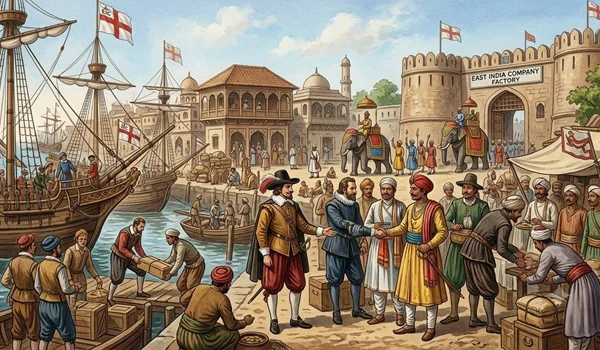
The East India Company was established on 30 December 1600, when Queen Elizabeth I granted its founding charter.
The charter gave the company exclusive rights to trade with territories broadly described as the East Indies. The original corporate name was the Governor and Company of Merchants of London Trading into the East-Indies.
The British Library's India Office Records preserve the charter and related documents concerning the company's rights and privileges.
Therefore, there is an important distinction between:
| Event | Date |
| East India Company established in England | 1600 |
| English trading activity reaches India | Early 1600s |
| Early English factory established at Surat | 1612 |
| Trading rights at Surat obtained | 1614 |
| Battle of Plassey | 1757 |
| Company loses its trading monopoly in India | 1813, with important exceptions and later changes |
| Company loses remaining major commercial privileges | 1833 |
| Company rule effectively ends after the Revolt of 1857 | 1858 |
These dates help explain why saying simply that the "East India Company was established in India" can be misleading. The company itself was established in England in 1600; its Indian trading and political presence developed later.
Who Established the East India Company?
The company was created by English merchants who wanted to participate in the profitable Asian trade.
Queen Elizabeth I granted the royal charter that formally incorporated the company. The charter named Thomas Smythe as its first governor.
The group consisted of merchants and investors who were prepared to finance long-distance trading voyages.
At the beginning, the company was fundamentally a commercial organisation rather than a government.
Its activities were based on the expectation that trade with Asian markets could generate substantial profits.
Why Was the East India Company Established?
European merchants were competing intensely for access to Asian trade.
Products such as spices, silk, cotton textiles and other Asian commodities were highly valuable in European markets.
English merchants wanted a direct role in this trade rather than depending entirely on existing European trading networks.
The East India Company was therefore created to:
- Organise overseas trading voyages
- Raise investment capital
- Obtain commercial privileges
- Establish trading settlements
- Purchase Asian goods
- Transport goods to European markets
- Compete with other European trading companies
The company was given a monopoly over English trade within the geographical area specified by its charter.
When Did the East India Company Arrive in India?
The company's activities in India developed during the early seventeenth century.
One of the earliest English voyages to India was associated with William Hawkins, who reached the Mughal court during the reign of Emperor Jahangir.
The English initially faced strong competition from the Portuguese, who already had an established presence in Indian waters.
The English gradually expanded their position through trade, diplomacy and competition with other European powers.
Surat became particularly important because it was one of the major ports connected with the commercial networks of the Mughal Empire.
East India Company's First Factory in India
Surat is generally associated with the establishment of the East India Company's early permanent trading presence in India.
The English established a trading centre or factory at Surat in 1612, following growing English commercial activity in the region.
The term "factory" in this historical context did not mean a modern manufacturing plant.
An East India Company factory was essentially a trading post or commercial establishment where company employees lived, stored goods, negotiated with merchants and conducted business.
The Surat Municipal Corporation's historical records identify 1612 as the year when the British established a trading centre or kothi at Surat.
In 1614, Sir Thomas Roe's diplomatic mission helped the English secure greater trading rights from the Mughal authorities.
Why Was Surat Important to the East India Company?
Surat was one of India's major ports during the seventeenth century.
It was connected to extensive domestic and international trading networks and served merchants dealing in textiles and other valuable commodities.
For the East India Company, Surat provided access to:
- Cotton textiles
- Indigo
- Silk-related goods
- Other Indian commodities
- Overseas shipping networks
The company's presence in Surat gave English merchants a stronger base from which to expand their activities in India.
Surat remained an important English trading centre for many years.
What Was an East India Company Factory?
The word "factory" can cause confusion when reading about the company's history.
It did not necessarily refer to a manufacturing facility.
A company factory was a commercial settlement where "factors" or company representatives carried out trade.
A factory could contain:
- Warehouses
- Offices
- Residential quarters
- Storage facilities
- Trading areas
- Administrative spaces
- Security arrangements
Factors negotiated purchases, managed goods and maintained relationships with local authorities and merchants.
As European companies became more established, some trading settlements developed into fortified centres.
Expansion Beyond Surat
The East India Company did not remain confined to Surat.
It established or developed trading centres in several parts of the Indian subcontinent.
Important locations included:
- Surat
- Masulipatam
- Madras
- Bombay
- Bengal
- Calcutta
The company's expansion followed commercial opportunities and strategic considerations.
Different regions offered access to different products and markets.
The Coromandel Coast, for example, was especially important for cotton textiles.
Bengal became increasingly significant because of its wealth, agricultural production, textiles and strategic location.
Establishment of Madras
The English established an important settlement at Madras, now Chennai, during the seventeenth century.
Fort St George became a major English centre on the Coromandel Coast.
The region was commercially important because of its textile production.
Indian cotton textiles were highly sought after in international markets.
Madras therefore became an important part of the company's growing network of Indian trading settlements.
How Did Bombay Come Under the East India Company?
Bombay, now Mumbai, became another major centre of English power.
The Portuguese had controlled Bombay before it passed into English hands through the marriage settlement associated with King Charles II of England and Catherine of Braganza of Portugal.
Charles II subsequently transferred control of Bombay to the East India Company in the seventeenth century.
Bombay gradually developed into one of the company's most important western Indian bases.
Its natural harbour and strategic location eventually contributed greatly to its commercial importance.
Establishment of Calcutta
Bengal became one of the company's most important areas of operation.
The English developed a settlement at Calcutta, which eventually became the centre of British administration in Bengal.
Fort William was constructed as an important English stronghold.
The economic importance of Bengal played a major role in the company's later transformation from a trading organisation into a territorial power.
From Trading Company to Political Power
The East India Company's transformation was gradual.
Initially, its primary goal was to make profits from trade.
However, competition among European powers, conflicts with Indian rulers and the need to protect trading settlements led the company to become increasingly involved in military and political affairs.
The company began maintaining armed forces and fortifications.
This changed its role significantly.
Instead of simply buying and selling goods, the company increasingly became involved in:
- Diplomacy
- Military conflicts
- Political alliances
- Tax collection
- Administration
- Territorial expansion
This transition was one of the most important developments in the history of British India.
Battle of Plassey and the Company's Rise
The Battle of Plassey, fought in 1757 in Bengal, was a major turning point.
The East India Company forces under Robert Clive defeated the forces of Nawab Siraj-ud-Daulah.
The victory significantly strengthened the company's political influence in Bengal.
Plassey did not immediately create British rule over the whole of India, but it provided the company with a much stronger political and financial position.
Bengal became central to the company's expansion.
Battle of Buxar
The company's position became even stronger after the Battle of Buxar in 1764.
The company defeated a coalition involving the Nawab of Bengal, the Nawab of Awadh and the Mughal emperor Shah Alam II.
The result strengthened the company's position in eastern India.
In 1765, the company obtained the Diwani rights, giving it the authority to collect revenue in Bengal, Bihar and Orissa under arrangements with the Mughal emperor.
This was a major change.
The company was no longer simply a merchant organisation.
It had acquired important revenue-collecting and administrative responsibilities.
How Did the East India Company Rule India?
The East India Company did not control the entire Indian subcontinent at once.
Its influence expanded gradually through a combination of:
- Military victories
- Treaties
- Political alliances
- Revenue arrangements
- Annexations
- Diplomacy
- Economic influence
Different parts of India remained under different Indian rulers for long periods.
The company's political system also changed over time.
British parliamentary intervention increased as the company's territorial responsibilities expanded.
Government Control Over the Company
The company's growing political power created concerns in Britain.
A private trading corporation had become responsible for governing large territories and populations.
The British Parliament therefore introduced legislation to increase government supervision.
One important development was the Regulating Act of 1773.
It increased parliamentary oversight and created the position of Governor-General of Bengal.
Further legislation followed, including Pitt's India Act of 1784.
These measures gradually increased British government control over the company's Indian administration.
End of the East India Company's Trading Monopoly
The company's commercial monopoly gradually weakened.
The Charter Act of 1813 ended much of the company's monopoly over trade with India, although important exceptions remained.
The company's monopoly over the China trade was later removed by the Charter Act of 1833.
After this transformation, the company increasingly functioned as an administrative authority rather than as a traditional trading corporation.
This distinction is important when studying the later history of the company.
East India Company and the Revolt of 1857
The company's administration faced a major crisis during the Indian Rebellion of 1857, also called the Revolt of 1857.
The uprising began among soldiers of the company's army and spread to several regions.
It involved soldiers, rulers, landlords, civilians and other groups, although its causes and impact varied considerably across regions.
The rebellion exposed serious weaknesses in the company's system of administration.
It also changed the British government's approach to governing India.
End of East India Company Rule
Following the events of 1857, the British Parliament passed the Government of India Act 1858.
The administration of India's territories was transferred from the East India Company to the British Crown.
This effectively ended the company's political rule in India.
The British Crown thereafter governed India directly through the new imperial administrative system.
The company continued to exist for a limited period after losing its governing role but was eventually dissolved in 1874.
East India Company Headquarters
The East India Company's corporate headquarters were in London, not India.
Its London headquarters played an important role in directing the company's overseas operations.
The company had a central management structure in Britain while its Indian settlements were managed through presidencies and local administrative institutions.
This created a distinctive system in which commercial decisions made in London could have major consequences for people and territories thousands of kilometres away.
Major Indian Presidencies
As the company's power expanded, three major administrative presidencies became especially important:
Bengal Presidency
Bengal became the company's most powerful administrative centre after its victories in eastern India.
Calcutta was the capital and a major centre of administration and commerce.
Madras Presidency
The Madras Presidency covered large parts of southern India under British control.
Madras, now Chennai, was its principal administrative centre.
Bombay Presidency
The Bombay Presidency became an important western Indian administrative and commercial region.
Bombay, now Mumbai, developed into a major port and commercial centre.
East India Company and Indian Trade
Trade remained central to the company's history even after it became a political power.
The company dealt in numerous commodities.
Important Indian products included:
- Cotton textiles
- Silk
- Indigo
- Saltpetre
- Spices
- Tea
- Opium
Indian textiles were particularly important during the company's earlier commercial period.
The company's activities connected Indian producers and merchants with international markets, although the relationship increasingly became shaped by colonial economic policies.
Economic Impact of the East India Company
The company's economic impact on India was complex and remains an important subject of historical research.
On one side, the company connected Indian markets to international trade networks and expanded port-based commerce.
On the other side, its political power enabled it to influence taxation, trade conditions and economic policy.
Revenue extraction became an important source of funding for the company's military and administrative activities.
The company also increasingly operated within an economic system designed to support British commercial interests.
Therefore, the East India Company's history cannot be understood only as a story of international trade. Its commercial activities became closely connected with political authority and colonial rule.
East India Company and Indian Industries
The company's relationship with Indian industries changed significantly over time.
Indian cotton textiles were highly valuable in European markets during the company's early trading period.
However, the growth of British industrial manufacturing changed the economic relationship.
Britain increasingly became a major producer of machine-made textiles, while India became an important source of raw materials and a market for British manufactured goods.
This shift had major consequences for traditional Indian textile-producing communities.
The economic effects differed across regions and industries, making the subject more complicated than a simple decline-or-growth narrative.
East India Company and Modern India
The East India Company no longer exists as a governing or trading power.
Its historical importance, however, remains highly relevant to understanding India's modern political and economic development.
Several major Indian cities developed into important commercial and administrative centres during the company's period.
These included:
- Mumbai
- Chennai
- Kolkata
- Surat
The company's activities also influenced:
- Indian taxation systems
- Administrative structures
- Military organisation
- International trade
- Port development
- Commercial institutions
- Colonial law
- Political geography
Many institutions created or expanded during the colonial period later became part of the historical foundations of modern India.
Was the East India Company a British Government Company?
No. The East India Company was originally a private joint-stock trading company established under a royal charter.
It was not initially the British government itself.
However, as its political and territorial power increased, the British government increasingly regulated and supervised it.
After 1858, the company lost its governing authority in India, and direct administration passed to the British Crown.
This is why the company is historically unusual: it began as a commercial corporation but eventually exercised many powers normally associated with a state.
Why Is the East India Company Important in Indian History?
The East India Company is important because its activities played a major role in the transition from European commercial involvement to British colonial rule in India.
Its history helps explain:
- The expansion of European trade in India
- The growth of British influence
- The decline of competing European powers
- The political transformation of Bengal
- The development of British administrative institutions
- The expansion of colonial territory
- The economic restructuring of India
- The events leading to direct Crown rule
For students and researchers, the company provides an important example of how commercial interests and political power can become closely connected.
Frequently Asked Questions
When was the East India Company established?
The East India Company was established in 1600 when Queen Elizabeth I granted its royal charter to a group of English merchants.
Was the East India Company established in India?
No. The company was established in England in 1600. Its trading operations in India developed during the early seventeenth century.
Where was the first East India Company factory in India?
Surat is generally identified with one of the company's earliest permanent factories in India, established in 1612. The company also developed early trading operations on the Coromandel Coast, including at Masulipatam.
Who gave permission to the East India Company to trade in India?
The company obtained trading privileges through negotiations with Mughal authorities. Sir Thomas Roe's mission to Emperor Jahangir was particularly important in securing expanded English trading rights.
Why did the East India Company come to India?
The company initially came to India for commercial purposes. It wanted to purchase valuable Indian and Asian commodities and sell them in international markets.
When did the East India Company become a political power?
The company's political influence expanded significantly during the eighteenth century. The Battle of Plassey in 1757 was a major turning point, followed by the company's acquisition of revenue-collection rights in Bengal in 1765.
When did the East India Company's rule end in India?
Company rule effectively ended in 1858, following the Revolt of 1857 and the Government of India Act 1858, which transferred administration to the British Crown.
When was the East India Company dissolved?
The East India Company was formally dissolved in 1874, after it had already lost its political and commercial importance in India.
Conclusion
The East India Company was established in England in 1600, not in India. It was created as a commercial organisation to participate in the profitable trade between England and Asia.
Its Indian presence developed during the early seventeenth century, with Surat becoming one of its earliest important trading centres. From there, the company expanded to other parts of India, including Madras, Bombay and Bengal.
The company's history changed dramatically during the eighteenth century. Military victories such as Plassey and Buxar, combined with political alliances and revenue rights, transformed it from a trading organisation into a major territorial power.
By the nineteenth century, the company had lost much of its original commercial monopoly and increasingly functioned as an administrative authority. The Revolt of 1857 ultimately led to the end of company rule, with the British Crown taking direct control of India in 1858.
For anyone researching when the East India Company was established in India, the key point is simple: the company itself was founded in England in 1600, while its commercial and later political presence in India developed from the early 1600s onward.