Top Semiconductor Companies in India (2026): Leading Chip and Semiconductor Companies
 Jyoti Sirvastava
India's semiconductor industry is entering an important phase of development. For many years, India was particularly recognised for semiconductor design, engineering talent and research rather than large-scale chip manufacturing. That situation is now changing as major manufacturing, assembly, testing and packaging projects are being developed across the country.
Companies such as Tata Electronics, Micron Technology, CG Power and Kaynes Semicon are becoming important names in India's emerging semiconductor manufacturing ecosystem. At the same time, companies including Tata Elxsi, MosChip Technologies and Sasken Technologies have capabilities connected with semiconductor design, embedded systems and engineering services.
The Indian government has approved multiple semiconductor projects covering fabrication, assembly, testing and packaging. As of 2026, the approved projects represent more than ₹1.6 lakh crore of investment commitments, demonstrating the scale of India's semiconductor ambitions.
This article covers the top semiconductor companies in India based on their semiconductor manufacturing projects, technology capabilities, investment, ecosystem importance, chip-design expertise and current relevance.
Top Semiconductor Companies in India
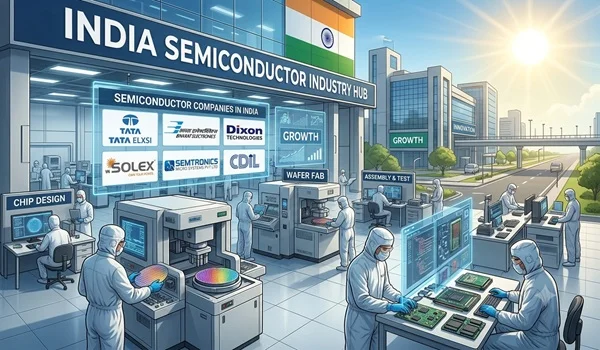
| Rank | Company | Major Semiconductor Area |
| 1 | Tata Electronics | Semiconductor fabrication and advanced packaging |
| 2 | Micron Technology | Memory assembly and testing |
| 3 | CG Power and Industrial Solutions | Semiconductor assembly and testing |
| 4 | Kaynes Technology / Kaynes Semicon | Semiconductor assembly and packaging |
| 5 | Continental Device India | Discrete semiconductor devices |
| 6 | Tata Elxsi | Semiconductor and embedded engineering |
| 7 | MosChip Technologies | Semiconductor design and engineering |
| 8 | Sasken Technologies | Semiconductor engineering and embedded technology |
| 9 | SiCSem | Silicon carbide semiconductors |
| 10 | 3D Glass Solutions | Advanced packaging and semiconductor substrates |
1. Tata Electronics
Tata Electronics is currently one of the most important companies in India's semiconductor manufacturing plans.
The Tata Group company is developing a semiconductor fabrication facility at Dholera in Gujarat in partnership with Powerchip Semiconductor Manufacturing Corporation of Taiwan. The approved project has an investment commitment of approximately ₹91,526 crore and planned capacity of around 50,000 wafer starts per month.
Tata Electronics is also developing a semiconductor assembly and testing facility in Assam. The project has an approved investment of approximately ₹27,120 crore and uses semiconductor packaging technologies for high-volume production.
Key areas of Tata Electronics
- Semiconductor fabrication
- Wafer manufacturing
- Semiconductor packaging
- Assembly and testing
- Electronics manufacturing
- Chip supply chain development
Tata Electronics is significant because its projects cover different stages of the semiconductor value chain rather than focusing on only one activity.
2. Micron Technology
Micron Technology is a global semiconductor and memory technology company with a major manufacturing project in Gujarat.
The company is establishing an assembly and test facility at Sanand for DRAM and NAND products. The project has an investment commitment of approximately ₹22,516 crore and planned production capacity of around 14 million units per week.
Micron's Indian facility is particularly important because memory products are essential components in computers, smartphones, data centres, automotive systems and other electronic devices.
Key areas of Micron
- DRAM
- NAND
- Memory products
- Semiconductor assembly
- Semiconductor testing
- Data-centre technology
Micron's presence also gives India an opportunity to become more integrated into the global memory semiconductor supply chain.
3. CG Power and Industrial Solutions
CG Power has become an important Indian participant in semiconductor manufacturing through its semiconductor unit in Sanand, Gujarat.
The company's semiconductor project is being developed through a partnership involving Renesas Electronics and Stars Microelectronics. The approved investment is approximately ₹7,584 crore.
The facility is focused on semiconductor assembly and testing and is intended to serve sectors including automotive, industrial electronics, consumer electronics and telecommunications.
Key areas of CG Power
- Semiconductor assembly
- Semiconductor testing
- Power semiconductors
- Automotive electronics
- Industrial electronics
- Telecom applications
CG Power is particularly interesting because its semiconductor initiative builds on its existing industrial and electrical technology background.
4. Kaynes Technology and Kaynes Semicon
Kaynes Technology has expanded beyond electronics manufacturing services into the semiconductor manufacturing ecosystem through Kaynes Semicon.
The company is developing a semiconductor facility in Sanand, Gujarat. The approved project has an investment of approximately ₹3,307 crore and planned capacity of more than 6.33 million chips per day under the government's approved project framework.
Kaynes' semiconductor ambitions are closely connected with India's broader electronics manufacturing ecosystem.
Key areas of Kaynes Semicon
- Semiconductor packaging
- Assembly and testing
- Electronics manufacturing
- Automotive electronics
- Industrial electronics
- Consumer electronics
The company is strategically positioned between electronics manufacturing and semiconductor production.
5. Continental Device India
Continental Device India, commonly known as CDIL, is one of India's established semiconductor device manufacturers.
Unlike large semiconductor fabs that focus on complex integrated circuits, CDIL has a significant presence in discrete semiconductor devices.
The company is expanding its semiconductor manufacturing facility in Punjab under the approved semiconductor programme. The project focuses on high-power discrete semiconductor devices, with applications in automotive systems, renewable energy, consumer electronics and industrial equipment.
Key areas of CDIL
- Discrete semiconductor devices
- Power electronics
- High-power diodes
- Automotive applications
- Renewable energy systems
- Industrial electronics
CDIL is important because India's semiconductor ecosystem needs manufacturers across different technology segments, not only advanced logic chips.
6. Tata Elxsi
Tata Elxsi is not a conventional semiconductor fabrication company. Its importance comes primarily from engineering, embedded systems, semiconductor-related software and product development.
The company works with technology and automotive businesses and has capabilities across embedded software, electronics design, digital engineering and product development.
Key areas of Tata Elxsi
- Semiconductor engineering
- Embedded systems
- Automotive electronics
- Software-defined vehicles
- Product engineering
- Digital engineering
Tata Elxsi represents the design and engineering side of India's semiconductor ecosystem.
This distinction is important: a semiconductor company does not necessarily need to own a fabrication plant. Chip design, verification, embedded software and electronic system engineering are also important parts of the semiconductor value chain.
7. MosChip Technologies
MosChip Technologies is an Indian semiconductor design and engineering company with capabilities in ASIC and SoC design, semiconductor verification and embedded systems.
The company is particularly relevant to India's semiconductor design ecosystem.
Key areas of MosChip
- ASIC design
- SoC design
- Semiconductor verification
- Silicon engineering
- Embedded systems
- Digital engineering
India has historically had strong semiconductor design capabilities, and companies such as MosChip demonstrate the country's role beyond manufacturing.
8. Sasken Technologies
Sasken Technologies is an Indian product engineering and technology services company with expertise in semiconductor, embedded and communication technologies.
The company works across product engineering and connected technology environments, making it relevant to semiconductor-dependent industries.
Key areas of Sasken
- Semiconductor engineering
- Embedded systems
- Wireless technology
- Automotive technology
- Product engineering
- Software development
Sasken's role is mainly on the engineering and design side rather than large-scale semiconductor fabrication.
9. SiCSem
SiCSem is an emerging semiconductor company focused on silicon carbide technology.
Silicon carbide is an important material for power electronics because of its applications in electric vehicles, renewable energy, industrial equipment and other high-power systems.
The company's semiconductor project in Odisha has been approved under India's semiconductor programme. The project includes wafer production and semiconductor packaging capabilities.
Key areas of SiCSem
- Silicon carbide semiconductors
- Power electronics
- Semiconductor wafers
- Semiconductor packaging
- Electric vehicle applications
- Renewable energy applications
SiCSem is therefore particularly relevant to India's future power semiconductor ecosystem.
10. 3D Glass Solutions
3D Glass Solutions is developing semiconductor-related manufacturing capabilities in Odisha.
Its approved project covers glass panel substrate production, assembly and heterogeneous integration. These technologies are associated with advanced semiconductor packaging.
The company represents a specialised part of India's emerging semiconductor supply chain.
Key areas of 3D Glass Solutions
- Glass panel substrates
- Advanced packaging
- Heterogeneous integration
- Semiconductor assembly
- Advanced electronics
Semiconductor Companies in India by Business Area
The semiconductor industry is much broader than traditional chip manufacturing. Different companies participate at different stages.
| Business Area | Examples |
| Semiconductor fabrication | Tata Electronics |
| Memory assembly and testing | Micron |
| Semiconductor assembly and testing | CG Power, Kaynes Semicon |
| Discrete semiconductors | CDIL |
| Silicon carbide | SiCSem |
| Advanced packaging | Tata Electronics, 3D Glass Solutions |
| Semiconductor design | MosChip |
| Semiconductor engineering | Tata Elxsi, Sasken |
| Electronics and embedded systems | Kaynes Technology, Tata Elxsi |
This distinction is useful when researching semiconductor companies because a chip designer, semiconductor packaging company and wafer fabrication company perform very different functions.
India's Semiconductor Manufacturing Projects
India's semiconductor policy has moved from an emphasis on attracting investment to developing a broader domestic ecosystem.
The government has approved semiconductor projects across several states. These include fabs, assembly and testing units, specialised semiconductor facilities and advanced packaging projects.
The approved projects under India's semiconductor programme represent investment commitments of more than ₹1.6 lakh crore and cover multiple parts of the semiconductor value chain.
The India Semiconductor Mission is responsible for supporting the development of India's semiconductor and display ecosystem.
What Is a Semiconductor Fab?
A semiconductor fabrication plant, commonly called a fab, is a facility where semiconductor wafers are manufactured and integrated circuits are created through highly controlled manufacturing processes.
A fab requires:
- Highly clean manufacturing environments
- Advanced lithography and processing equipment
- Semiconductor-grade materials
- Extremely precise process control
- Large capital investment
- Skilled engineering teams
- Reliable water and electricity infrastructure
Tata Electronics' planned facility in Dholera is particularly significant because it represents India's push toward domestic semiconductor fabrication. The project is being developed with technology partnership support from PSMC of Taiwan.
What Is OSAT or ATMP?
OSAT stands for Outsourced Semiconductor Assembly and Test. ATMP stands for Assembly, Testing, Marking and Packaging.
These facilities generally handle semiconductor processes after wafers have been manufactured.
Their activities can include:
- Semiconductor assembly
- Packaging
- Testing
- Marking
- Quality inspection
- Final product preparation
Companies such as Micron, CG Power and Kaynes are important to this part of India's semiconductor ecosystem.
Why Is India Investing in Semiconductors?
Semiconductors are fundamental components of modern electronics.
They are used in:
- Smartphones
- Computers
- Cars
- Electric vehicles
- Telecommunications equipment
- Data centres
- Industrial machines
- Medical equipment
- Defence electronics
- Consumer appliances
- Renewable energy systems
India's dependence on imported semiconductor components has made domestic semiconductor capability a strategic priority.
The government launched the Semicon India Programme with an original outlay of ₹76,000 crore, while subsequent semiconductor initiatives have expanded support for manufacturing and the wider ecosystem. In 2026, the government also approved Semicon 2.0 with an outlay of ₹1,27,500 crore.
India's Semiconductor Design Strength
Manufacturing receives significant attention, but semiconductor design is another major strength of India.
Indian engineers have long worked for global semiconductor companies on:
- Chip architecture
- Verification
- Physical design
- Embedded software
- Firmware
- ASIC development
- SoC development
- Electronic design automation
The government's semiconductor programme also supports design-focused startups and MSMEs.
India's semiconductor ecosystem therefore includes both manufacturing companies and companies involved in chip design, engineering and software.
Major Semiconductor Hubs in India
Gujarat
Gujarat has emerged as India's most important semiconductor manufacturing cluster.
Sanand is home to projects involving Micron, CG Power and Kaynes, while Dholera is the location of Tata Electronics' semiconductor fab project.
Assam
Tata Electronics is developing a major semiconductor assembly and testing facility in Assam.
The project is important for expanding advanced electronics manufacturing beyond India's traditional industrial centres.
Punjab
Continental Device India is expanding semiconductor manufacturing capacity in Punjab, with a focus on discrete semiconductor devices.
Odisha
Odisha is attracting specialised semiconductor projects, including silicon carbide and advanced packaging-related projects.
Future of Semiconductor Companies in India
India's semiconductor industry is still developing, which means the competitive landscape is likely to change significantly over the coming years.
The country's immediate opportunity is not necessarily to compete with every global semiconductor manufacturer across every advanced technology node. Instead, India can build strength across multiple segments including mature-node manufacturing, memory assembly, power semiconductors, packaging, testing, chip design and electronics integration.
Artificial intelligence, electric vehicles, renewable energy, telecommunications and data centres are likely to increase semiconductor demand.
The introduction of Semicon 2.0 in 2026 also signals a longer-term policy focus on semiconductor equipment and materials, chip design, Indian intellectual property, research and supply-chain resilience.
FAQs About Semiconductor Companies in India
Which is the biggest semiconductor company in India?
There is no single official ranking for the biggest semiconductor company in India because companies participate in different parts of the semiconductor value chain. Tata Electronics currently stands out because of the scale of its approved semiconductor fabrication and packaging investments.
Which companies are manufacturing semiconductors in India?
Important semiconductor manufacturing and packaging projects involve Tata Electronics, Micron Technology, CG Power, Kaynes Semicon, Continental Device India and other approved project developers.
Which company is building India's first semiconductor fab?
Tata Electronics is developing a major semiconductor fabrication facility at Dholera in Gujarat in partnership with PSMC of Taiwan.
Is Micron manufacturing chips in India?
Micron's Indian facility is focused on assembly and testing of memory products including DRAM and NAND. It is therefore an important part of semiconductor manufacturing, although it is not the same as wafer fabrication.
Which semiconductor companies are listed in India?
Several Indian listed companies have semiconductor or semiconductor-related exposure, including CG Power, Kaynes Technology, MosChip Technologies and Tata Elxsi. However, their semiconductor involvement differs considerably, so investors should examine the specific business segment rather than treating them as identical semiconductor manufacturers.
Is India good for semiconductor manufacturing?
India has significant advantages including engineering talent, a large electronics market, growing manufacturing capabilities and strong government support. Building a complete semiconductor ecosystem, however, requires substantial investment, specialised infrastructure, technology partnerships, skilled manpower and reliable supply chains.
Which state is the semiconductor hub of India?
Gujarat currently has the strongest concentration of major approved semiconductor manufacturing projects, particularly around Sanand and Dholera.
Conclusion
The Indian semiconductor industry is moving from a design-led ecosystem toward a more complete semiconductor value chain that includes fabrication, assembly, testing, packaging and specialised semiconductor manufacturing.
Tata Electronics is emerging as a central player because of the scale of its planned fab and packaging projects. Micron brings global memory manufacturing expertise, while CG Power and Kaynes are developing important assembly and testing capabilities. CDIL, SiCSem and advanced packaging companies add further depth to the ecosystem.
At the same time, India's semiconductor design and engineering capabilities remain an important competitive advantage. Companies such as MosChip, Tata Elxsi and Sasken contribute to this part of the industry.
As semiconductor investments expand, India is likely to see greater participation across chip design, manufacturing, packaging, testing, equipment, materials and electronics. The coming years could therefore be important in determining India's position in the global semiconductor supply chain.