Public Companies in India: Top Listed Companies, Sectors, Types, Shares & Jobs
 Jyoti Sirvastava
Public companies are an important part of India's corporate and stock-market ecosystem. These companies can raise capital from investors and, when their securities are listed, their shares can be traded on recognised stock exchanges.
India has thousands of listed companies operating in sectors such as banking, IT, automobiles, pharmaceuticals, energy, FMCG, infrastructure, telecommunications, manufacturing and retail.
Some of India's best-known public companies include Reliance Industries, TCS, HDFC Bank, Infosys, ICICI Bank, Bharti Airtel and Larsen & Toubro.
What Is a Public Company?
A public company is a company that is not a private company under the Companies Act and can have a wider shareholder base. However, public company and publicly listed company are not exactly the same thing.
A public company can be unlisted, while a listed company has its securities listed on a recognised stock exchange. SEBI's regulations specifically define a listed entity in relation to securities being listed on a recognised stock exchange.
This distinction is important because people often use the term "public company" to mean a company whose shares are available for trading on the stock market.
Public Company vs Public Sector Company
These two terms should not be confused.
| Public Company | Public Sector Company |
| Legal/company structure | Government ownership or control |
| Can be privately owned | Government is a controlling owner |
| May be listed or unlisted | May be listed or unlisted |
| Example: TCS | Example: ONGC |
| Can have private promoters | Government is a major owner |
For example, TCS is a public listed company but is not a public-sector company. ONGC is a public-sector enterprise and is also listed on the stock exchange.
Top Public Companies in India
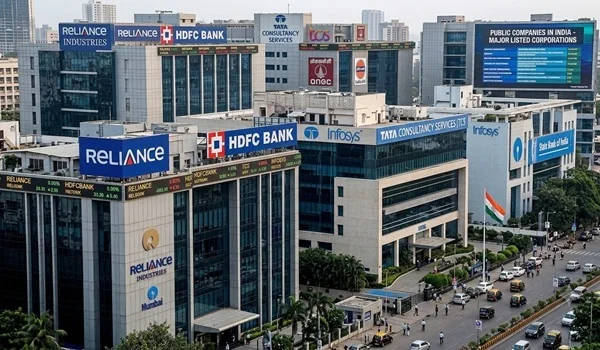
Some major Indian public companies include:
| Company | Major Sector |
| Reliance Industries | Energy, Retail & Digital |
| Tata Consultancy Services | IT Services |
| HDFC Bank | Banking |
| ICICI Bank | Banking |
| Infosys | IT Services |
| Bharti Airtel | Telecommunications |
| Larsen & Toubro | Engineering & Infrastructure |
| Tata Motors | Automobiles |
| ITC | FMCG & Consumer Goods |
| Hindustan Unilever | FMCG |
| Mahindra & Mahindra | Automobiles |
| Axis Bank | Banking |
| Bajaj Finance | Financial Services |
| Sun Pharmaceutical Industries | Pharmaceuticals |
| Asian Paints | Paints & Consumer Products |
| Titan Company | Consumer & Retail |
| Maruti Suzuki India | Automobiles |
| UltraTech Cement | Cement |
| Adani Enterprises | Infrastructure & Energy |
| HCLTech | IT Services |
The list is not a fixed ranking. Companies can be compared by revenue, market capitalisation, profit, assets or other financial measures.
Listed Public Companies in India
A large portion of India's major public companies are listed on the NSE or BSE.
Examples include:
- Reliance Industries
- TCS
- Infosys
- HDFC Bank
- ICICI Bank
- Bharti Airtel
- Tata Motors
- Larsen & Toubro
- ITC
- Asian Paints
- Sun Pharma
- Maruti Suzuki
- Mahindra & Mahindra
When a company's shares are listed, investors can generally buy and sell those shares through the stock market, subject to applicable market rules. SEBI notes that listing provides investors with greater liquidity and tradability compared with unlisted securities.
Public Companies in India by Industry
- IT and Technology
India has a large group of publicly listed technology companies.
Major examples include:
- TCS
- Infosys
- HCLTech
- Wipro
- Tech Mahindra
- LTIMindtree
- Persistent Systems
- Mphasis
These businesses provide software development, IT consulting, cloud services, cybersecurity, artificial intelligence and digital transformation services.
- Banking and Financial Services
India's financial sector contains some of the country's largest listed companies.
Major private-sector examples include:
- HDFC Bank
- ICICI Bank
- Axis Bank
- Kotak Mahindra Bank
- IndusInd Bank
- Bajaj Finance
- Shriram Finance
There are also listed public-sector banks such as SBI, Bank of Baroda and Punjab National Bank.
- Automobile Companies
Major listed automobile companies include:
- Tata Motors
- Maruti Suzuki India
- Mahindra & Mahindra
- Bajaj Auto
- Eicher Motors
- TVS Motor Company
- Ashok Leyland
The industry includes passenger vehicles, commercial vehicles, motorcycles, scooters and automotive components.
- Pharmaceutical Companies
India's listed pharmaceutical industry includes:
- Sun Pharmaceutical Industries
- Dr. Reddy's Laboratories
- Cipla
- Lupin
- Zydus Lifesciences
- Aurobindo Pharma
- Torrent Pharmaceuticals
- Divi's Laboratories
These companies serve both Indian and international markets.
- FMCG and Consumer Goods
Major listed consumer companies include:
- ITC
- Hindustan Unilever
- Nestlé India
- Britannia Industries
- Dabur India
- Marico
- Godrej Consumer Products
- Tata Consumer Products
Their products cover food, beverages, personal care and household categories.
- Energy and Oil Companies
India's stock market also has several large listed energy companies.
Examples include:
- Reliance Industries
- ONGC
- Indian Oil
- BPCL
- HPCL
- GAIL
- Oil India
These businesses operate in areas such as oil exploration, refining, natural gas, fuel marketing and energy.
- Infrastructure and Engineering
Infrastructure is another major segment of India's listed corporate sector.
Examples include:
- Larsen & Toubro
- Adani Enterprises
- Adani Ports
- Siemens India
- ABB India
- KEC International
- NCC
They operate in construction, engineering, ports, industrial infrastructure, energy and related areas.
- Telecommunications
India's listed telecom sector includes:
- Bharti Airtel
- Vodafone Idea
Reliance Jio's parent structure is also a major part of India's telecommunications industry, while its planned public-market developments have attracted significant attention. In August 2026, SEBI approved Jio Platforms' proposed IPO, which could become one of India's largest public listings if completed.
Public Companies and the Stock Market
One of the biggest advantages of becoming a listed public company is access to the capital markets.
A company can raise funds through methods such as:
- Initial Public Offering (IPO)
- Follow-on Public Offer (FPO)
- Rights issue
- Qualified institutional placement
- Other permitted securities offerings
An IPO is the process through which an eligible company offers shares to the public and seeks listing on a stock exchange.
India's IPO market continues to be active. As of September 2026, the reported IPO pipeline included hundreds of companies seeking approval or preparing for public offerings, showing the continuing interest in India's public markets.
How Does a Company Become Public?
A company generally needs to meet applicable legal and regulatory requirements before offering securities to the public and seeking listing.
The broad process can include:
- Preparing the company for an IPO
- Appointing advisors and intermediaries
- Preparing offer documents
- Meeting regulatory requirements
- Filing documents with SEBI and stock exchanges
- Receiving necessary approvals
- Launching the public issue
- Allotting shares
- Listing the shares on a recognised stock exchange
The actual process is more detailed and depends on the type of issue and applicable regulations.
Advantages of Being a Public Company
Becoming a public company, particularly a listed company, can provide several benefits.
Access to Capital
A public offering can help a company raise substantial funds for expansion, acquisitions, debt reduction or other corporate purposes.
Greater Visibility
Stock-market listing can increase a company's visibility among investors, customers and business partners.
Liquidity for Shareholders
Listed shares can generally be traded on the stock exchange, giving shareholders an avenue to buy or sell their holdings.
Corporate Growth
Public companies can use capital markets to support expansion into new products, markets and geographies.
Employee Benefits
Listed companies may use employee stock options and other equity-based compensation arrangements, subject to applicable rules.
Challenges of Being a Public Company
Public companies also have additional responsibilities.
They generally need to comply with:
- Disclosure requirements
- Financial reporting requirements
- Corporate governance rules
- Stock-exchange regulations
- Investor communication requirements
- SEBI regulations
Listed companies must also disclose important information to investors within the applicable regulatory framework.
This means becoming a public company can increase transparency but also creates additional compliance responsibilities.
Public Companies vs Private Companies
| Feature | Public Company | Private Company |
| Shareholders | Can be broad | More restricted |
| Public issue | Permitted subject to law | Cannot invite public to subscribe to securities |
| Share transfer | Generally less restricted | Restrictions apply |
| Stock-market listing | Can be listed | Cannot list as a private company |
| Disclosure | Higher for listed companies | Generally lower |
| Capital raising | Public markets available if eligible | Private sources |
It is worth remembering that public company does not automatically mean listed company. An unlisted public company can exist without its shares being traded on a stock exchange.
Public Companies and Employment
Large public companies are also major employers in India.
Common career areas include:
- Information Technology
- Finance
- Accounting
- Marketing
- Sales
- Human Resources
- Engineering
- Manufacturing
- Supply Chain
- Legal
- Operations
- Research and Development
Public companies may also offer graduate programmes, management trainee positions, internships and specialist roles.
Public Companies vs Public Sector Companies vs MNCs
These three terms describe different things.
| Category | What It Mainly Describes | Example |
| Public Company | Legal/company structure | TCS |
| Public Sector Company | Government ownership/control | ONGC |
| MNC | Operations across countries | Microsoft |
A company can fall into more than one category.
For example, an Indian public-sector company can also be listed, while an Indian private-sector company can operate internationally and therefore have multinational characteristics.
Why Are Public Companies Important to India?
Public companies contribute to India's economy in several ways.
Capital Formation
Stock markets allow businesses to raise capital from investors and support long-term expansion.
Investment Opportunities
Listed companies give individuals and institutions opportunities to invest in Indian businesses.
Transparency
Listed companies have extensive disclosure and reporting obligations, helping investors access information about their businesses.
Employment
Large listed businesses employ people across multiple sectors and cities.
Economic Growth
Public companies contribute to production, exports, infrastructure, innovation and tax revenues.
FAQs About Public Companies in India
What is a public company in India?
A public company is a company that is not a private company under company law and can have a wider shareholder base. It may be listed or unlisted.
Is every public company listed?
No. A public company can be unlisted. A listed company is one whose securities are listed on a recognised stock exchange.
What are the top public companies in India?
Some major public companies include Reliance Industries, TCS, HDFC Bank, ICICI Bank, Infosys, Bharti Airtel, Larsen & Toubro, Tata Motors and ITC.
Is a public company the same as a PSU?
No. A PSU refers to a public-sector enterprise, generally associated with government ownership or control. A public company is a legal/company classification and can be privately controlled.
Can anyone buy shares of a public company?
If the company's shares are listed and available for trading, investors can generally buy them through the stock market using a suitable brokerage and demat account.
What is the difference between a public company and a listed company?
A public company describes the company's corporate form, while a listed company refers to a company whose securities are listed on a recognised stock exchange.
Why do companies go public?
Companies may go public to raise capital, provide liquidity to existing shareholders, increase visibility and support future business expansion.
Final Thoughts
Public companies form a major part of India's corporate and investment ecosystem. They operate across IT, banking, automobiles, pharmaceuticals, FMCG, energy, telecommunications, infrastructure and manufacturing.
It is important to distinguish between a public company, listed company, private-sector company and public-sector company, as these terms describe different aspects of a business.
With India's capital markets continuing to expand and companies increasingly looking toward IPOs and other fundraising options, public companies will remain an important part of the country's business landscape.