Miniratna Companies in India: Category I & II, List, Eligibility, Powers & Jobs
 admin
Miniratna companies are a category of Central Public Sector Enterprises (CPSEs) recognised by the Government of India for their financial performance and operational strength. These companies are given greater financial and administrative autonomy than other CPSEs.
The Miniratna category is divided into Miniratna Category-I and Miniratna Category-II. Companies in this group operate in sectors such as aviation, defence, railways, engineering, mining, shipping, petroleum, telecom, infrastructure and renewable energy.
According to the Department of Public Enterprises' Public Enterprises Survey 2024-25, Miniratna CPSEs are classified separately as Category-I and Category-II enterprises.
What Is a Miniratna Company?
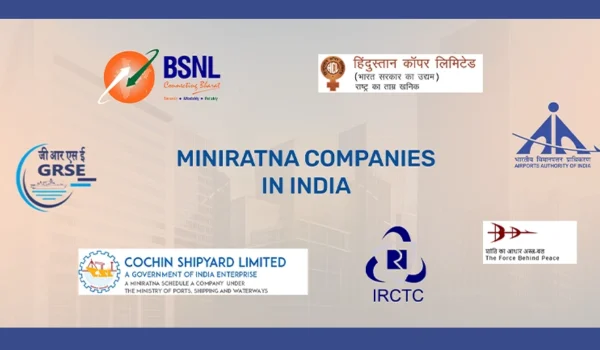
A Miniratna company is a Central Public Sector Enterprise that meets prescribed financial and performance conditions and receives additional autonomy from the Government of India.
The Miniratna scheme was introduced to allow financially sound CPSEs to take certain business and investment decisions without seeking government approval for every matter.
There are two categories:
- Miniratna Category-I
- Miniratna Category-II
Category-I companies generally have greater financial powers than Category-II companies.
Miniratna Companies in India List
The latest Public Enterprises Survey 2024-25 lists Miniratna-I CPSEs including Airports Authority of India, BEML, Bharat Dynamics, BSNL, Cochin Shipyard, Garden Reach Shipbuilders & Engineers, Goa Shipyard, Hindustan Copper and others.
Miniratna Category-I Companies
Some of the important Miniratna Category-I companies are:
| No. | Company | Major Sector |
| 1 | Airports Authority of India (AAI) | Aviation |
| 2 | Antrix Corporation Limited | Space |
| 3 | Balmer Lawrie & Co. Limited | Diversified Services |
| 4 | BEML Limited | Engineering & Defence |
| 5 | Bharat Coking Coal Limited | Coal Mining |
| 6 | Bharat Dynamics Limited | Defence |
| 7 | Bharat Sanchar Nigam Limited (BSNL) | Telecom |
| 8 | Braithwaite & Co. Limited | Engineering |
| 9 | Bridge & Roof Company (India) Limited | Construction |
| 10 | Central Coalfields Limited | Coal Mining |
| 11 | Central Electronics Limited | Electronics |
| 12 | Central Mine Planning & Design Institute Limited | Mining Consultancy |
| 13 | Chennai Petroleum Corporation Limited | Petroleum |
| 14 | Cochin Shipyard Limited | Shipbuilding |
| 15 | EdCIL (India) Limited | Education Consultancy |
| 16 | Garden Reach Shipbuilders & Engineers Limited | Defence & Shipbuilding |
| 17 | Goa Shipyard Limited | Shipbuilding & Defence |
| 18 | Grid Controller of India Limited | Power |
| 19 | Hindustan Copper Limited | Mining |
| 20 | Hindustan Organic Chemicals Limited | Chemicals |
The official 2024-25 DPE survey continues the Category-I list beyond these companies.
Other Category-I Miniratna CPSEs include companies such as Hindustan Steelworks Construction Company, HLL Lifecare, India Tourism Development Corporation, Indian Railway Catering and Tourism Corporation, Indian Railway Finance Corporation, Indian Renewable Energy Development Agency, KIOCL, Mahanadi Coalfields, Mishra Dhatu Nigam, MSTC, National Fertilizers, National Seeds Corporation, NHPC, Northern Coalfields, NEEPCO, Numaligarh Refinery, RailTel, RITES, SJVN, THDC India and WAPCOS.
Miniratna Category-II Companies
Category-II Miniratna companies form a smaller group of CPSEs with financial autonomy below Category-I.
Important examples include:
| No. | Company | Major Sector |
| 1 | Artificial Limbs Manufacturing Corporation of India | Healthcare Manufacturing |
| 2 | Bharat Pumps & Compressors Limited | Engineering |
| 3 | Broadcast Engineering Consultants India Limited (BECIL) | Electronics & Consultancy |
| 4 | Engineering Projects (India) Limited | Engineering & Construction |
| 5 | FCI Aravali Gypsum & Minerals India Limited | Minerals |
| 6 | Ferro Scrap Nigam Limited | Metal Recycling |
| 7 | HMT (International) Limited | Engineering & Services |
| 8 | Indian Medicines & Pharmaceuticals Corporation Limited | Pharmaceuticals |
| 9 | MECON Limited | Engineering Consultancy |
| 10 | Mineral Exploration Corporation Limited | Mining & Exploration |
| 11 | National Film Development Corporation | Media & Film |
| 12 | Rajasthan Electronics & Instruments Limited | Electronics |
The exact composition of Miniratna categories can change because CPSEs may be upgraded, reclassified, merged, closed or otherwise change status. The DPE's Public Enterprises Survey is the appropriate official reference for the current classification.
Miniratna Category-I vs Category-II
The two categories mainly differ in their eligibility requirements and financial powers.
| Feature | Miniratna Category-I | Miniratna Category-II |
| Profitability | Higher prescribed performance | Profitability required |
| Net worth | Positive net worth | Positive net worth |
| Financial autonomy | Higher | Lower |
| Capital expenditure powers | Greater | More limited |
| Business decision-making | Greater autonomy | Moderate autonomy |
| Position | Higher Miniratna category | Lower Miniratna category |
The government framework has historically linked Category-I eligibility with continuous profitability for three years, positive net worth and a pre-tax profit of at least ₹30 crore in at least one of those years. Category-II requires continuous profitability for three years and positive net worth, along with other prescribed conditions.
Eligibility for Miniratna Status
A CPSE must satisfy specific conditions before it can receive Miniratna status.
Miniratna Category-I
Broadly, a CPSE must:
- Have made profits continuously for the previous three years.
- Have earned a prescribed level of pre-tax profit in at least one of those years.
- Have a positive net worth.
- Meet other government conditions relating to financial performance and obligations.
Miniratna Category-II
The basic financial requirements include:
- Continuous profitability for the previous three years.
- Positive net worth.
- Compliance with other applicable government conditions.
Miniratna CPSEs should also not be dependent on budgetary support or government guarantees for their normal operations, subject to the applicable policy framework.
Financial Powers of Miniratna Companies
One of the biggest benefits of Miniratna status is greater financial freedom.
Instead of referring every investment decision to the government, eligible companies can make specified capital expenditure decisions within the powers delegated to their boards.
Historically, Category-I Miniratnas have had higher investment powers than Category-II Miniratnas. The exact limits and conditions should be checked against the latest DPE guidelines because government policies can be revised.
This autonomy can help companies:
- Start new projects
- Purchase equipment
- Modernise facilities
- Expand operations
- Enter new business areas
- Improve infrastructure
- Take faster commercial decisions
Miniratna Companies by Sector
Miniratna CPSEs operate across a wide range of industries.
Aviation
Airports Authority of India is one of the best-known Miniratna companies. It is involved in airport infrastructure and air-navigation-related services.
Defence
Companies such as:
- Bharat Dynamics
- Garden Reach Shipbuilders & Engineers
- Goa Shipyard
- Mishra Dhatu Nigam
support India's defence manufacturing and strategic industrial capabilities.
Railways
Several Miniratna companies are associated with Indian Railways and railway-related services.
Examples include:
- IRCTC
- RailTel
- RITES
- SJVN and other infrastructure-related CPSEs
Mining and Metals
The category includes companies involved in:
- Coal mining
- Copper
- Mineral exploration
- Mining consultancy
- Mineral processing
Examples include Bharat Coking Coal, Central Coalfields, Hindustan Copper and Mineral Exploration Corporation.
Engineering and Construction
Miniratna companies also operate in engineering, project management and construction.
Examples include:
- BEML
- Braithwaite & Co.
- Bridge & Roof Company
- Engineering Projects India
- MECON
- WAPCOS
Energy and Petroleum
The category includes companies involved in petroleum refining, renewable energy and power-sector activities.
Examples include:
- Chennai Petroleum Corporation
- Numaligarh Refinery
- Indian Renewable Energy Development Agency
- NHPC
- NEEPCO
Telecom and Technology
BSNL is one of the most prominent Miniratna-related CPSE examples in the telecom sector, while other enterprises operate in electronics, IT and technical consultancy.
Miniratna Companies and Stock Market Listing
Miniratna status and stock-market listing are two different things.
A Miniratna company may be:
- Listed on a stock exchange
- Unlisted
- A subsidiary or specialised CPSE
- A government-owned enterprise operating in a strategic sector
For example, BEML, Bharat Dynamics, Cochin Shipyard, IRCTC, RailTel and Hindustan Copper are examples of Miniratna-related companies that have been publicly traded.
Therefore, investors should not assume that every Miniratna company has shares available on NSE or BSE.
Miniratna Companies and Government Jobs
Miniratna companies are important employers for people seeking careers in the public sector.
Job opportunities can be available in areas such as:
- Engineering
- Finance
- Human resources
- Information technology
- Operations
- Project management
- Procurement
- Administration
- Research and development
- Defence production
- Aviation
- Mining
Recruitment methods vary by company. Some CPSEs recruit through examinations, interviews, campus recruitment, apprenticeships or other selection processes.
Salary and Career Growth in Miniratna Companies
Salary varies considerably depending on the company, post, grade, qualification and experience.
Technical and managerial employees may receive:
- Basic salary
- Dearness allowance
- House-related benefits
- Performance-related pay
- Medical benefits
- Retirement benefits
- Other company-specific allowances
Because Miniratna companies operate in different industries, their salary structures and career opportunities are not identical.
Miniratna vs Navratna vs Maharatna
India's Ratna classification gives different levels of autonomy to eligible CPSEs.
| Category | General Level of Autonomy |
| Maharatna | Highest |
| Navratna | Very high |
| Miniratna-I | Moderate to high |
| Miniratna-II | Moderate |
Maharatna companies are generally the largest and most strategically important CPSEs under the Ratna framework. Navratna companies receive substantial autonomy, while Miniratnas receive autonomy based on their category and eligibility.
The DPE's official classification lists Maharatna, Navratna and Miniratna CPSEs separately.
Why Are Miniratna Companies Important?
Miniratna CPSEs contribute to India's economy in several ways.
Employment Generation
They provide direct employment and also support thousands of contractors, suppliers and service providers.
Infrastructure Development
Companies working in aviation, railways, construction, power and engineering contribute to infrastructure development.
Strategic Industries
Defence, mining, petroleum, telecom and other strategic sectors include several Miniratna enterprises.
Regional Development
Many CPSEs operate mines, factories, projects and offices outside India's major metropolitan cities, supporting local economies.
Greater Management Autonomy
The Miniratna framework allows financially performing CPSEs to take certain business decisions more quickly.
The Department of Public Enterprises collects information on CPSE turnover, employment, investment, profits and other economic indicators through the Public Enterprises Survey.
Can a Miniratna Company Become a Navratna?
Yes, a Miniratna company can potentially move to a higher category if it satisfies the eligibility and performance requirements prescribed by the Government of India.
The general progression can be viewed as:
Other CPSE → Miniratna → Navratna → Maharatna
However, this is not an automatic promotion system. A company must satisfy the applicable criteria for the higher classification.
Frequently Asked Questions
How many Miniratna companies are there in India?
The number can change because CPSEs are periodically upgraded, reclassified or otherwise change their status. The latest DPE Public Enterprises Survey should be used for the current official count and list.
What are the two types of Miniratna companies?
There are Miniratna Category-I and Miniratna Category-II companies.
Which is higher, Miniratna-I or Miniratna-II?
Miniratna Category-I is the higher category and generally provides greater financial autonomy than Category-II.
Is BSNL a Miniratna company?
BSNL appears in the Department of Public Enterprises' Miniratna-I classification in the official 2024-25 survey.
Is BEML a Miniratna company?
Yes. BEML is listed as a Miniratna-I CPSE in the 2024-25 DPE classification.
Are all Miniratna companies listed on NSE and BSE?
No. Miniratna status and stock-market listing are separate classifications. Some Miniratna companies are listed, while others are unlisted.
Is Miniratna a government job?
Miniratna is a classification of a CPSE, not a type of job. Employees working for these companies may have public-sector employment, but recruitment conditions depend on the individual CPSE.
Final Thoughts
Miniratna companies are an important part of India's Central Public Sector Enterprise system. They include businesses working in aviation, defence, railways, mining, engineering, petroleum, telecom, power and infrastructure.
The two categories—Miniratna-I and Miniratna-II—provide different levels of financial autonomy based on the company's performance and eligibility.
For job seekers, these companies can offer opportunities in technical, managerial and administrative fields. For the Indian economy, they support infrastructure, strategic industries, employment and industrial development.
Because the list of CPSEs can change over time, the Department of Public Enterprises' latest Public Enterprises Survey is the best reference when checking the current Miniratna classification.
Good Luck