Top 10 Largest Companies in India by Revenue
 admin
adminThe largest companies in India by revenue are led by some of the country's biggest names in oil and gas, banking, insurance, automobiles, IT, infrastructure and telecommunications.
Revenue is one of the best ways to measure the business scale of a company. However, a company with high revenue is not necessarily the most profitable or the most valuable on the stock market.
According to the latest Fortune India 500 2025 ranking, Reliance Industries is India's largest company by total income, followed by Life Insurance Corporation of India (LIC), Indian Oil Corporation, State Bank of India and ONGC. The 500 companies together crossed $2 trillion in total income for the first time.
Top 10 Largest Companies in India by Revenue
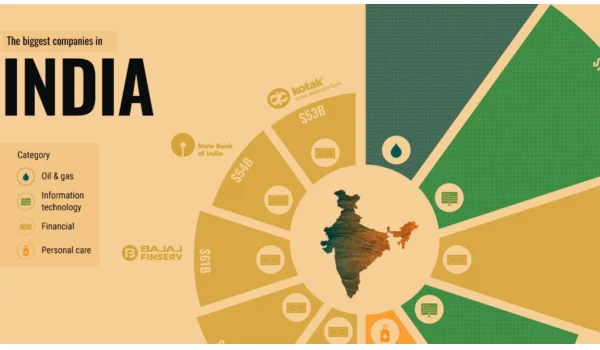
The following companies occupy the top positions in the latest Fortune India 500 ranking:
| Rank | Company | Sector | Total Income / Revenue* |
| 1 | Reliance Industries | Oil & Gas / Diversified | ₹9,97,795 crore |
| 2 | Life Insurance Corporation of India | Insurance | ₹8,93,465 crore |
| 3 | Indian Oil Corporation | Oil & Gas | ₹7,66,008 crore |
| 4 | State Bank of India | Banking | ₹6,63,343 crore |
| 5 | ONGC | Oil & Gas | ₹6,24,805 crore |
| 6 | HDFC Bank | Banking | ₹4,70,916 crore |
| 7 | Tata Motors | Automobile | ₹4,48,844 crore |
| 8 | Bharat Petroleum Corporation | Oil & Gas | ₹4,42,483 crore |
| 9 | ICICI Bank | Banking | ₹3,22,748 crore |
| 10 | Larsen & Toubro | Engineering & Infrastructure | ₹2,55,734 crore |
*Fortune India uses Total Income as its ranking metric, so these figures should not be treated as identical to accounting revenue for every type of company, particularly banks and insurers. The figures above are from Fortune India 500 2025.
- Reliance Industries
Reliance Industries Limited (RIL) is the largest company in India by total income in the latest Fortune India 500 ranking.
It has businesses across:
- Oil and petrochemicals
- Refining
- Retail
- Telecommunications
- Digital services
- New energy
- Media and entertainment
Reliance reported total income of approximately ₹9.98 lakh crore in the Fortune India 500 2025 ranking.
- Life Insurance Corporation of India
LIC is India's largest life insurance company and the second-largest company in the Fortune India 500 2025 ranking by total income.
Its business includes:
- Life insurance
- Savings products
- Pension products
- Investment-linked products
- Group insurance
LIC's position also shows why revenue comparisons between different industries need to be interpreted carefully. Insurance companies have very different income structures from manufacturing companies.
- Indian Oil Corporation
Indian Oil Corporation (IOCL) is one of India's largest energy companies.
Its activities include:
- Oil refining
- Fuel marketing
- Petroleum products
- Natural gas
- Petrochemicals
- Fuel distribution
Indian Oil recorded total income of about ₹7.66 lakh crore in Fortune India 500 2025.
- State Bank of India
State Bank of India (SBI) is India's largest public-sector bank and ranked fourth overall.
Its operations cover:
- Retail banking
- Corporate banking
- Loans
- Deposits
- Digital banking
- Investment banking
- International banking
SBI's total income was approximately ₹6.63 lakh crore in the Fortune India 500 2025 ranking.
- ONGC
Oil and Natural Gas Corporation (ONGC) is India's leading state-owned oil and gas exploration and production company.
Its operations include:
- Oil exploration
- Natural gas production
- Offshore production
- Oil and gas development
- International energy activities
ONGC ranked fifth with total income of approximately ₹6.25 lakh crore.
- HDFC Bank
HDFC Bank is one of India's largest private-sector banks.
Its major business areas include:
- Retail banking
- Corporate banking
- Personal loans
- Home loans
- Credit cards
- Digital banking
- Treasury services
It ranked sixth in the Fortune India 500 2025 list with total income of approximately ₹4.71 lakh crore.
- Tata Motors
Tata Motors is one of India's largest automobile companies and ranked seventh in the 2025 Fortune India 500.
Its business covers:
- Passenger vehicles
- Commercial vehicles
- Electric vehicles
- Jaguar Land Rover through its group structure
Tata Motors had total income of roughly ₹4.49 lakh crore in the ranking.
- Bharat Petroleum Corporation
Bharat Petroleum Corporation Limited (BPCL) is another major government-owned energy company.
Its businesses include:
- Oil refining
- Petrol and diesel marketing
- LPG
- Aviation fuel
- Lubricants
- Petrochemicals
BPCL ranked eighth in Fortune India 500 2025.
- ICICI Bank
ICICI Bank is one of India's largest private-sector banks.
It provides:
- Retail banking
- Corporate banking
- Loans
- Credit cards
- Wealth management
- Digital financial services
- International banking
ICICI Bank ranked ninth in the Fortune India 500 2025 ranking.
- Larsen & Toubro
Larsen & Toubro (L&T) is one of India's largest engineering and infrastructure groups.
Its businesses include:
- Infrastructure
- Construction
- Heavy engineering
- Energy
- Defence
- Technology services
- Manufacturing
L&T completed the top 10 in Fortune India 500 2025.
Top 15 Largest Companies in India by Revenue
The top 15 companies in the latest Fortune India 500 ranking are:
| Rank | Company | Major Sector |
| 1 | Reliance Industries | Oil & Gas / Diversified |
| 2 | LIC | Insurance |
| 3 | Indian Oil Corporation | Oil & Gas |
| 4 | State Bank of India | Banking |
| 5 | ONGC | Oil & Gas |
| 6 | HDFC Bank | Banking |
| 7 | Tata Motors | Automobile |
| 8 | Bharat Petroleum | Oil & Gas |
| 9 | ICICI Bank | Banking |
| 10 | Larsen & Toubro | Infrastructure |
| 11 | Tata Consultancy Services | IT Services |
| 12 | Hindalco Industries | Metals |
| 13 | Tata Steel | Steel |
| 14 | NTPC | Power |
| 15 | Bharti Airtel | Telecommunications |
Fortune India's official ranking confirms these top 15 positions for 2025.
Largest Companies in India by Sector
Revenue rankings also show which industries have the greatest corporate scale in India.
Oil and Gas
Energy companies dominate the highest positions because of the enormous value of crude oil, petroleum products and natural gas.
Major companies include:
- Reliance Industries
- Indian Oil
- ONGC
- BPCL
- Hindustan Petroleum
- GAIL
- Oil India
Banking and Financial Services
Major financial companies include:
- SBI
- HDFC Bank
- ICICI Bank
- Axis Bank
- Bajaj Finance
- Bank of Baroda
- Punjab National Bank
Banks can report very large income figures because of their interest and other financial income.
Automobile
Important automobile companies include:
- Tata Motors
- Mahindra & Mahindra
- Maruti Suzuki
- Bajaj Auto
- Hero MotoCorp
- Eicher Motors
IT
India's major technology companies include:
- TCS
- Infosys
- HCLTech
- Wipro
- Tech Mahindra
- LTIMindtree
TCS ranked 11th overall in Fortune India 500 2025.
Metals and Steel
Large Indian metals companies include:
- Hindalco Industries
- Tata Steel
- JSW Steel
- Vedanta
- SAIL
Power and Infrastructure
Major companies include:
- NTPC
- Power Grid Corporation
- Larsen & Toubro
- Adani Enterprises
- Adani Power
- Tata Power
Telecommunications
The Indian telecom sector has major players such as:
- Bharti Airtel
- Vodafone Idea
- Reliance-related telecom businesses
Bharti Airtel ranked 15th in the Fortune India 500 2025 list.
Private vs Government Companies by Revenue
India's largest companies include both private-sector businesses and government-owned enterprises.
Major Private Companies
Examples include:
- Reliance Industries
- HDFC Bank
- Tata Motors
- ICICI Bank
- Larsen & Toubro
- TCS
- Bharti Airtel
- Hindalco Industries
- Tata Steel
Major Government-Owned Companies
Examples include:
- LIC
- Indian Oil
- SBI
- ONGC
- BPCL
- NTPC
- Power Grid
- Coal India
This makes India's corporate landscape a combination of large private groups and strategically important public-sector enterprises.
Why Do Oil Companies Dominate Revenue Rankings?
One reason is the high value of products sold.
Oil companies deal in commodities that can generate enormous sales even when profit margins are relatively modest.
For example, Reliance Industries, Indian Oil, ONGC and BPCL occupy several of the highest positions in the Fortune India ranking.
Therefore, revenue alone does not tell us which company is financially strongest.
A company with lower revenue can have:
- Higher profit
- Better margins
- Lower debt
- Higher return on capital
- Higher market capitalisation
Revenue vs Profit vs Market Capitalisation
These three measures are often confused.
| Metric | What it tells you |
| Revenue / Total Income | Size of business activity |
| Profit | Money left after expenses |
| Market Capitalisation | Market value of a listed company's equity |
| Total Assets | Value of assets owned/controlled |
| Net Worth | Shareholders' equity |
For example, a bank may have enormous total income and assets, while an IT company may have lower revenue but significantly higher profit margins.
Largest Companies by Revenue vs Most Valuable Companies
The largest company by revenue is not necessarily the most valuable company by market capitalisation.
For example, Fortune India's 2025 data shows Reliance at No. 1 by total income, while the market-cap ranking is a separate measurement.
This distinction is important for investors and business researchers.
How Are India's Largest Companies Ranked?
A commonly used source is the Fortune India 500, which ranks India's biggest corporations based on revenue/total income.
Fortune India describes its Fortune 500 as a ranking of the country's biggest corporations based on revenue and provides additional data such as profit, assets, net worth, employees and market capitalisation.
The ranking therefore provides more than just a revenue list.
Why Are These Companies Important to India's Economy?
The largest Indian companies have a major influence on the country's economy.
They contribute through:
- Employment
- Capital investment
- Tax payments
- Infrastructure development
- Manufacturing
- Exports
- Energy supply
- Banking and credit
- Technology services
- Supply-chain development
Large corporations also support thousands of smaller businesses through vendors, distributors, contractors and service providers.
Frequently Asked Questions
Which is the largest company in India by revenue?
Reliance Industries is the largest company in the latest Fortune India 500 ranking based on total income, with approximately ₹9.98 lakh crore in 2025.
Which is the second-largest company in India by revenue?
Life Insurance Corporation of India (LIC) ranked second with total income of approximately ₹8.93 lakh crore.
Which Indian company has the highest revenue?
Based on the latest Fortune India 500 ranking, Reliance Industries has the highest total income among companies in India.
Which government company has the highest revenue in India?
Among the companies at the top of the Fortune India 500 2025 ranking, LIC is the highest-ranked government-owned enterprise, followed by Indian Oil and SBI.
Which is India's largest private company by revenue?
Reliance Industries is the highest-ranked private-sector company in Fortune India 500 2025.
Is revenue the same as profit?
No. Revenue measures the income generated from business activities, while profit is what remains after expenses and other applicable costs.
Are all the largest companies in India listed on the stock market?
No. Many large companies are listed, but company size by revenue and stock-market listing are separate concepts.
Which sector has the largest companies by revenue in India?
Oil and gas has a particularly strong presence at the top of India's revenue rankings, followed by banking, insurance, automobiles, infrastructure, IT and telecommunications.
Final Thoughts
The largest companies in India by revenue demonstrate the enormous scale of India's corporate economy. The latest Fortune India 500 ranking is led by Reliance Industries, LIC, Indian Oil, SBI and ONGC, with energy and financial services dominating the highest positions.
However, revenue should not be used alone to judge a company's strength. Profitability, debt, assets, market capitalisation, return on capital and long-term growth provide a more complete picture.
For business research, investment analysis and understanding India's corporate landscape, comparing companies across these different measures gives a much better view than looking at revenue alone.